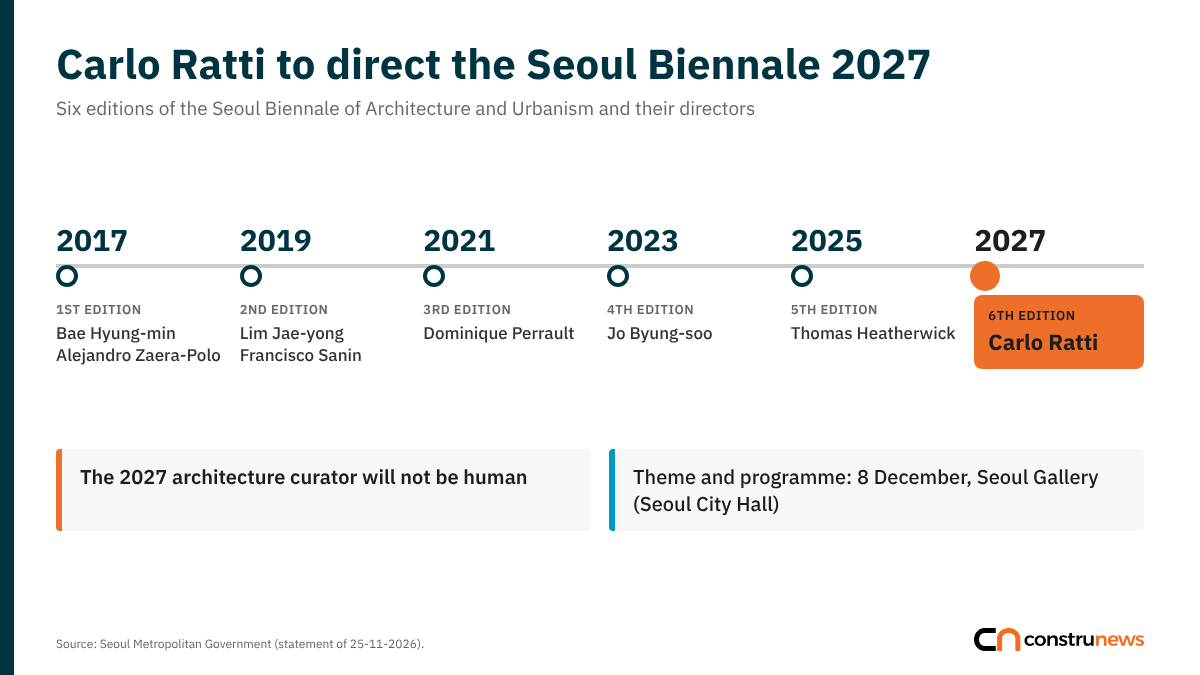

Seoul Metropolitan Government has appointed Carlo Ratti, the Italian architect and urban researcher, as General Director of the sixth Seoul Biennale of Architecture and Urbanism, to be held in 2027. The announcement, made public on 25 November, comes with an unusual statement of intent: according to Ratti himself, one of the biennale’s curators will not be a human being.
The Korean biennale was launched in 2017 and is held every two years. The city will work with the new director to refine the theme and exhibition direction, which will be presented at a preview event, the pre-biennale, scheduled for 8 December at the Seoul Gallery, on the first basement floor of Seoul City Hall.
A profile spanning architecture, cities and technology
Ratti is a professor at the Massachusetts Institute of Technology (MIT), where he directs the MIT Senseable City Lab, and at the Politecnico di Milano. He is also co-founder of the design practice CRA-Carlo Ratti Associati, established in 2002.
In 2025 he was director of the 19th International Architecture Exhibition of La Biennale di Venezia, which, under the title Intelligens. Natural. Artificial. Collective., put forward collective intelligence as a response to the challenges of the 21st century, as Construnews reported at the time (in Spanish). Previously he was chief curator of the 2019 Shenzhen Bi-City Biennale of Urbanism\Architecture, devised the Future Food District at Expo Milano 2015 and was creative mediator of Manifesta 14 (Prishtina, 2022).
Among his recent projects, Seoul Metropolitan Government highlights the Essential torch for the Milano Cortina 2026 Olympic and Paralympic Winter Games, the floating cultural square AquaPraça, awarded in the framework of COP30, and the CapitaSpring skyscraper in Singapore, designed with BIG. He is the author of books such as The City of Tomorrow and Atlas of the Senseable City, and his work has been exhibited at MoMA in New York and the Science Museum in London.
Seoul may be the best place in the world to explore new possibilities for citizen participation and urban curation with artificial intelligence
AI joins the curatorial team
The main novelty announced by Ratti concerns the organisation of the biennale itself. “Seoul may be the best place in the world to explore new possibilities for citizen participation and urban curation with AI,” the director said, adding that “there will be some surprise announcements, including the fact that the architecture curator is not a human being.”
Ratti has not yet explained what tasks this artificial curator will take on or how it will fit into the team. He did say that at the 8 December pre-biennale he will introduce the experts who will work with him on this edition.
The approach builds on the line Ratti followed in Venice, whose title already placed artificial intelligence alongside natural and collective intelligence, and on Seoul’s commitment to citizen participation in the event.
The architecture curator of the Seoul biennale will not be a human being, its new director has announced
A biennale with ten years of history
The Seoul Biennale of Architecture and Urbanism has so far had five editions and six directors:
- 2017: Bae Hyung-min and Alejandro Zaera-Polo.
- 2019: Lim Jae-yong and Francisco Sanin.
- 2021: Dominique Perrault.
- 2023: Jo Byung-soo.
- 2025: Thomas Heatherwick, under the motto Radically More Human.
- 2027: Carlo Ratti.
At the last edition, according to the city, thousands of citizens answered Heatherwick’s question about how to make Seoul more humane. The city now intends to build on the international network developed over this decade and on the results of citizen participation to broaden the biennale’s influence.
The sixth edition aims to bring the world’s knowledge to Seoul and design the city of the future together with its citizens
The mayor’s view
Seoul Mayor Oh Se-hoon stressed that, even as technology and the environment change, cities and architecture must ultimately serve people’s lives. Together with Ratti, he added, the sixth biennale aims to bring the world’s knowledge together in Seoul and design the city of the future with its citizens.

