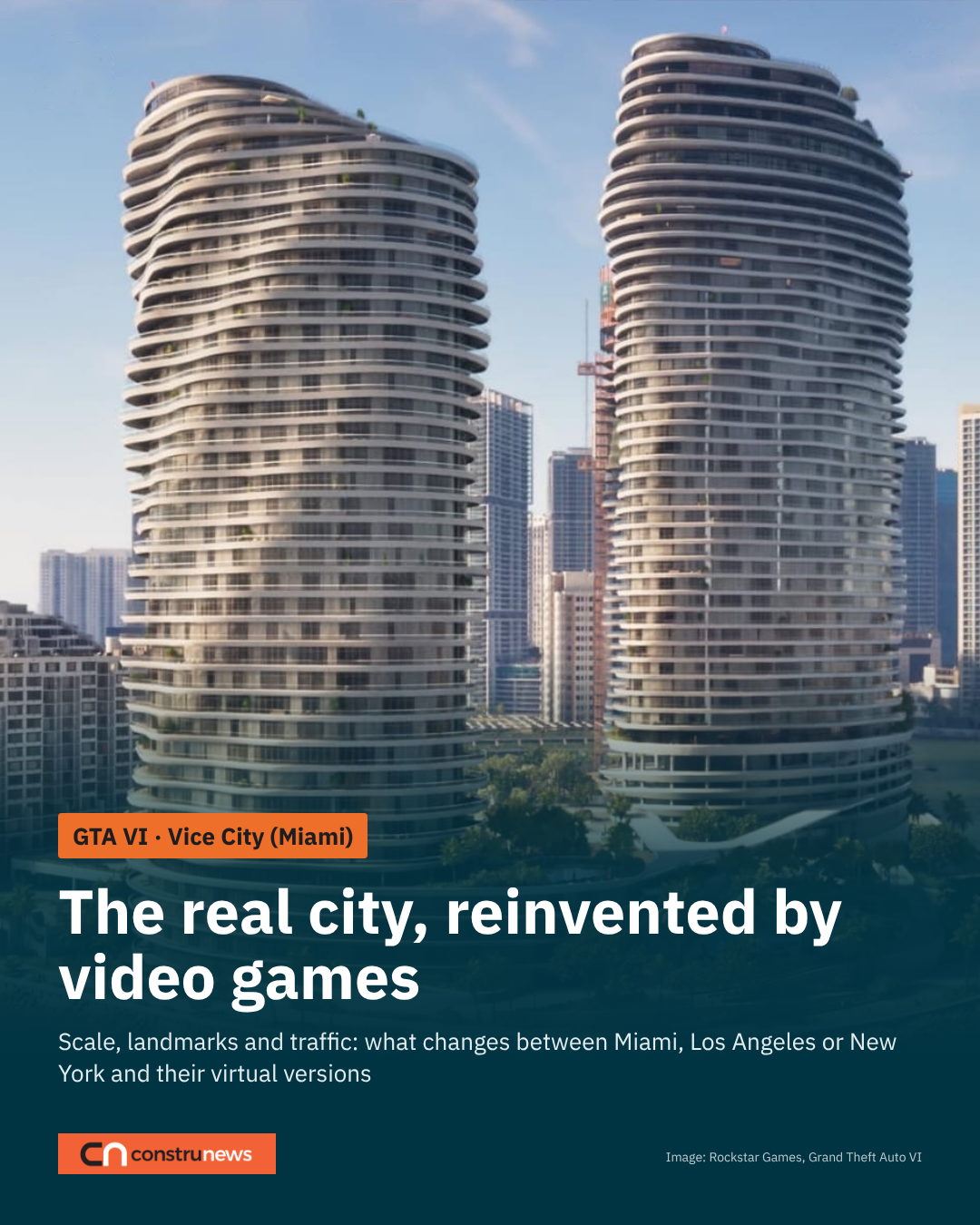

GTA VI is not set in Los Angeles but in Leonida, a compressed Florida with Vice City standing in for Miami. We compare its cities, and ten others reimagined by the industry, with the real ones, and look for the patterns that matter to architects and urban planners
Rockstar Games releases Grand Theft Auto VI today, 19 November, one of the most anticipated launches in video game history. Unlike its predecessor, set in a version of Los Angeles, the new title rebuilds Miami and South Florida. Real cities reimagined in the virtual world have become an urban laboratory that deserves a professional reading.
Grand Theft Auto VI arrives this Thursday on PlayStation 5 and Xbox Series X/S, as confirmed by Rockstar Games, which pushed the date back twice: the first trailer, released in December 2023, pointed to 2025; in May 2025 the game was delayed to 26 May 2026, and in November 2025 to 19 November 2026. The anticipation is hard to overstate: the second trailer, published on 6 May 2025, drew a record 475 million views in 24 hours across all platforms.
One starting point needs clarifying: GTA VI does not take place in Los Angeles. That city was the basis for Los Santos, the setting of Grand Theft Auto V (2013). The new game is set in the fictional state of Leonida, inspired by Florida, and its main city is Vice City, a stand-in for Miami, which the series already visited in 2002 with a 1986 setting.
A launch also measured in the office
Much has been said about the launch’s effect on workplace absenteeism, but the verified data are more modest than some viral figures. HR platform BambooHR, which analysed time-off requests from more than 3.4 million US employees in its customer base, found that requests for 19 November 2026 were 13% higher than on equivalent days in 2024 and 2025. The following Friday was up by about 11% and the weekend by about 9%. In the United Kingdom the increase for launch day was 8.3%, and in Canada 6.6%.
The same company commissioned a survey of 1,530 full-time US workers: 18% said they planned to take the day off, rising to 32% among Gen Z, and half of those planning to skip work for a game release said they would call in sick. This is a stated intention, not measured absence. By contrast, the figures of 1.5 million Americans missing work and $1 billion in lost productivity that have circulated in recent days are unsupported: a PolitiFact fact-check found no official survey or published study behind them.
Time-off requests for 19 November rose 13% in the US compared with equivalent days in 2024 and 2025
Leonida: Florida, compressed
The GTA VI map, which specialist outlets describe as roughly three times the playable area of Red Dead Redemption 2 (a figure not confirmed by Rockstar), follows the series’ logic of territorial compression. Vice City condenses Miami; Grassrivers reinterprets the Everglades, and the Leonida Keys the Florida Keys. Other fictional places, such as Ambrosia, Mount Kalaga National Park and Port Gellhorn, complete the territory. What in reality are hundreds of kilometres of motorway, wetland and coastline is reduced to a space that can be crossed in minutes, where each piece keeps only its most recognisable features.
Los Santos versus Los Angeles: the Rockstar method
The most studied precedent is GTA V. To build Los Santos, the Rockstar team took field trips across Southern California, gathering around 250,000 photographs and hours of video, used map projections of Los Angeles to lay out the road network and studied census data and documentaries. The result, which has shipped almost 230 million copies, is not a replica: it is an edited city. Los Angeles, with 1,302 km² within city limits and a far larger metropolitan sprawl, becomes a compact core where parody versions of Hollywood (Vinewood), the beaches of Santa Monica and Venice (Del Perro and Vespucci), the financial district and the desert sit just minutes apart by car.
The differences with the real city are mainly three. Scale: sprawl disappears, and with it the defining experience of Los Angeles, distance. Density of landmarks: where the real city interleaves miles of anonymous residential fabric, the virtual one strings together icons. And traffic: the car is still king, but congestion, the city’s structural problem, is softened so as not to spoil the game.
Los Santos is not a replica of Los Angeles, it is an edited city: distance disappears and landmarks multiply
Ten real cities reimagined
GTA is not an isolated case. The industry has spent decades reinterpreting existing metropolises with very different degrees of fidelity:
- Liberty City (New York). In GTA III (2001) it was a loose mix of New York with Philadelphia, Detroit or Chicago; in GTA IV (2008) it comes much closer to the original, with four boroughs that translate Brooklyn (Broker), Queens (Dukes), the Bronx (Bohan) and Manhattan (Algonquin).
- Kamurocho (Tokyo). Sega’s Yakuza / Like a Dragon series recreates Kabukicho, in Shinjuku, less than an hour from its studio. Real shops and arcades appear in their exact locations, to the point that a visitor to the real district would barely need the in-game map.
- 18th-century Paris. Assassin’s Creed Unity (2014) rebuilds the capital of the Revolution at roughly 1:1 scale, with historians as advisers. After the Notre-Dame fire in 2019, Ubisoft donated €500,000 and reused its cathedral model for a virtual tour, although its own team acknowledged that it was not historically accurate and that rumours about its use for the reconstruction were unfounded.
- Chicago, San Francisco and London. Ubisoft’s Watch Dogs series has visited all three. For Watch Dogs 2 (2016), the team made frequent scouting trips around the San Francisco Bay Area and redesigned places it could not reproduce; Watch Dogs: Legion (2020) imagines a dystopian near-future London.
- Manhattan. Marvel’s Spider-Man (2018) mixes the Empire State, the Chrysler Building and One World Trade Center with invented towers, such as Avengers Tower, in a borough designed to be travelled vertically.
- Lost Heaven (1930s United States). For the new version of Mafia (2020), Hangar 13 restyled the city after interwar American architecture and used data maps of players’ driving routes in the original game to move buildings and add shortcuts.
- Night City (California). Cyberpunk 2077 (2020) invents a megacity between Los Angeles and San Francisco. Its team consulted urban planners, drew on Brutalism and defined four architectural eras: Entropism, Kitsch, Neo-Militarism and Neo-Kitsch.
- The whole planet. Microsoft Flight Simulator (2020) generates the Earth from Bing Maps and artificial intelligence: more than 1.5 billion buildings and 2 million cities, with notable errors such as a Washington Monument rendered as a generic skyscraper.
Five patterns for reading the virtual city
The comparison yields patterns useful to anyone designing real cities. The first is selective compression: the game keeps the “image” of the city, in Kevin Lynch’s sense (recognisable landmarks, edges, paths and districts), and discards the fabric that does not define it. The second, the city as a route: it is designed to be moved through, whether by car, as in GTA, or swinging from skyscrapers, as in Spider-Man, and in Mafia it was even redesigned from users’ mobility data.
The third is parody as urban critique: GTA’s satire of consumerism, speculation and car dependency works as a commentary on the American city. The fourth, selective documentary fidelity: Kamurocho or Unity‘s Paris show that a game can document accurately, but the Notre-Dame case is a reminder that a convincing model is not a reliable survey. And the fifth, the future city as a thesis: Cyberpunk 2077 or Watch Dogs: Legion project current trends (surveillance, inequality, extreme verticality) with a freedom no master plan allows.
In a video game, the urban project needs no permit, developer or master plan, but it must work for whoever moves through it

