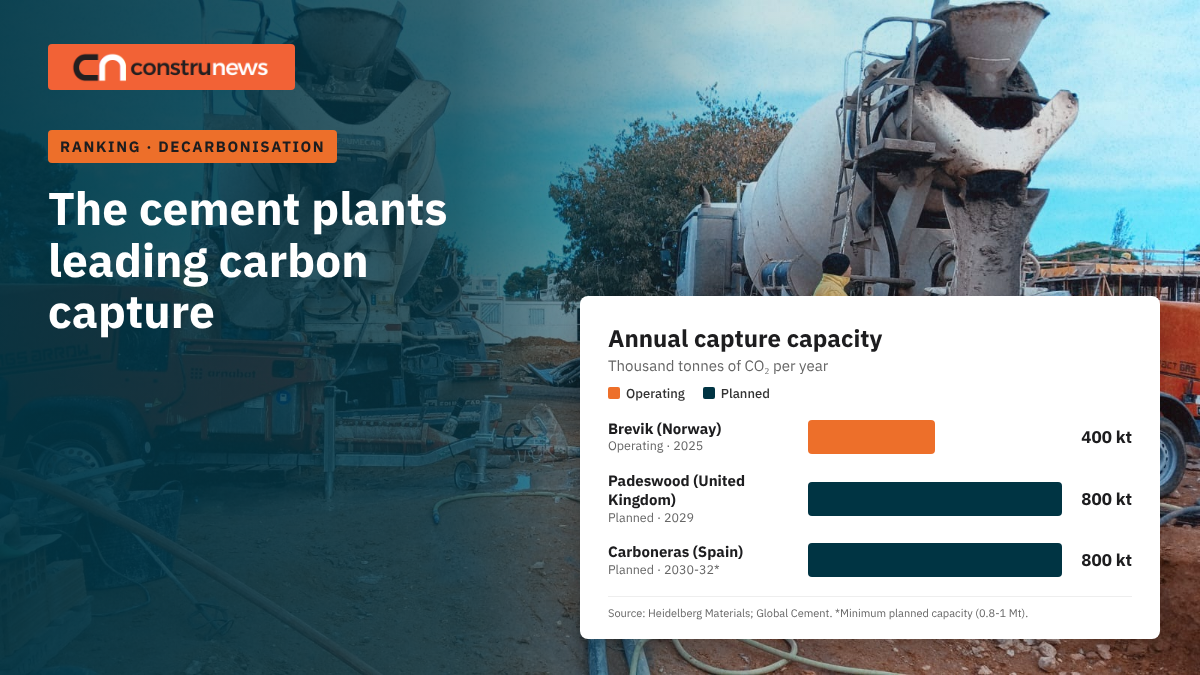

Carbon capture and storage (CCS) has moved from pilot projects to industrial scale in cement, one of the hardest sectors to decarbonise. Construnews reviews the plants leading this shift, with Brevik in operation since 2025 and a pipeline of projects targeting 2029 and 2030.
Cement production generates CO₂ emissions that depend not only on energy but on the chemical process of limestone itself. That is why carbon capture is seen as one of the key levers for achieving net-zero cement. In the last two years, the sector has made the leap from trials to the first industrial plants.
Brevik, the world’s first industrial plant
On 18 June 2025, Heidelberg Materials inaugurated Brevik CCS at its cement works in Brevik (Norway). It is the cement industry’s first industrial-scale carbon capture facility in the world. It captures around 400,000 tonnes of CO₂ a year, 50% of the plant’s emissions.
The captured CO₂ is liquefied and shipped to a terminal on Norway’s west coast, from where it is piped to permanent storage under the North Sea. That stage is handled by Northern Lights, a collaboration between Equinor, Shell and TotalEnergies. Brevik CCS is part of Longship, the Norwegian government project that forms Europe’s first full-scale carbon capture, transport and storage value chain for hard-to-abate industries.
The plant was built without disrupting cement production. The project required more than 1.2 million hours of technical work and the recruitment of 30 employees to operate it.
Brevik CCS captures 400,000 tonnes of CO₂ a year, half of the Norwegian plant’s emissions
evoZero, the first carbon captured cement
Brevik’s output is marketed under the evoZero brand, which Heidelberg Materials presents as the world’s first carbon captured cement enabling net-zero concrete. In October 2025, the company announced its first deliveries to customers in Europe.
Padeswood, the next step: 800,000 tonnes in 2029
The company’s second major project is at Padeswood in Wales (United Kingdom). On 25 September 2025, Heidelberg Materials took the final investment decision after reaching a funding agreement with the UK government. The facility is designed to capture around 800,000 tonnes of CO₂ a year, almost all of the plant’s emissions, and will be operational by 2029.
The CO₂ will be compressed and transported through an underground pipeline for storage under the seabed in Liverpool Bay, as part of the HyNet North West project. Padeswood will be the group’s second evoZero cement plant and the sector’s second industrial-scale CCS project to reach final investment decision. It will secure more than 200 jobs, around 50 of them new, and employ up to 500 people during construction.
Padeswood will capture 800,000 tonnes of CO₂ a year from 2029, twice as much as Brevik

Brevik’s CO₂ is liquefied and permanently stored under the North Sea
A pipeline looking to 2030
According to the company, Brevik is the first in a growing portfolio of carbon capture, utilisation and storage (CCUS) projects. Among the most advanced are Slite CCS in Sweden, which plans to capture up to 1.8 million tonnes of CO₂ a year by 2030, and GeZero in Geseke (Germany), supported by the EU Innovation Fund and scheduled to start operating in 2029.
In Spain, Holcim, together with Enagás and Saggas, is driving the CO2necta project, which will install a capture plant at its Sagunto (Valencia) factory. The CO₂ will be carried through Enagás’ infrastructure to the Saggas regasification plant, where it will be liquefied for shipping to geological storage. The project will cut more than 560,000 tonnes of CO₂ a year.

