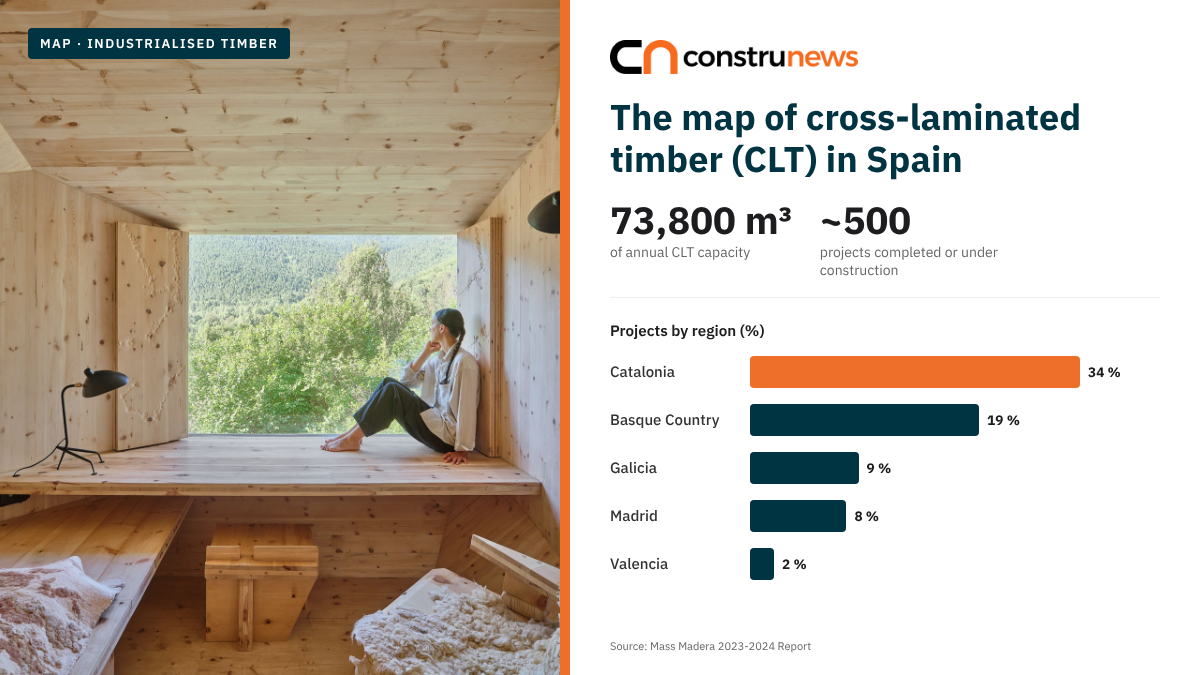
The map of cross-laminated timber in Spain: 73,800 m³ of capacity and close to 500 projects

Catalonia accounts for 34% of mass timber buildings completed or under construction, followed by the Basque Country (19%), Galicia (9%) and the Community of Madrid (8%)

The Data
73,800 m³ of CLT capacity, ~500 mass timber projects; Catalonia (34%) and the Basque Country (19%) lead.

Spain has an approximate production capacity of 73,800 m³ of cross-laminated timber (CLT), around 2.5% of the global total, according to the 2023-2024 report by the Mass Madera network. Construnews maps a material that has moved from single-family homes into multi-family and public housing.

Cross-laminated timber, known as CLT, has become one of the benchmark systems in industrialised construction. It consists of large panels made of layers of timber glued in alternating directions, produced in a factory and assembled dry on site. The reference source for measuring its uptake in Spain is the 2023-2024 Report by Mass Madera, the network of experts, companies, institutions and organisations pioneering the use of mass timber in building in Spain, including Tecnalia and FSC Spain.

Capacity concentrated in the north

According to the report, CLT production in Spain has an approximate production capacity of 73,800 m³. That capacity is concentrated in the Basque Country, Galicia and Catalonia, with Aragon soon to follow. With global capacity estimated at 7 million m³, Spain represents around 2.5% of the total.

The report expects production capacity to double within three years. There is ample room for growth: timber currently accounts for between 0.5% and 1.5% of construction, and the report estimates that it could reach 3% in 2026.

Raw material is not the issue. Spain has 26.3 million hectares of forest and is the second-largest country in the European Union by forest area, behind only Sweden.

Spain accounts for around 2.5% of global CLT capacity, estimated at 7 million m³

Where mass timber is being built

Mass Madera counts close to 500 projects completed or under construction using industrialised mass timber in Spain. Their regional distribution is highly uneven:

  • Catalonia: 34% of projects.
  • Basque Country: 19%.
  • Galicia: 9%.
  • Community of Madrid: 8%.
  • Valencian Community: 2%.

Catalonia and the Basque Country together account for more than half of the country’s mass timber buildings. They are also two of the regions where CLT manufacturing is concentrated.-

Catalonia and the Basque Country account for 53% of the nearly 500 mass timber buildings completed or under construction

From single-family homes to public housing

The report notes a shift in uses. Mass timber used to be employed mainly in single-family homes, long-span roofs and refurbishment. It is now also used in urban densification, mid-rise buildings and large-volume facilities.

Of all projects, 22% are multi-family housing and 46.1% are public developments. The weight of public authorities as clients confirms the role of public procurement in spreading the system, a topic Construnews covered in its first data report on industrialised construction in Spain (in Spanish).

Almost half of mass timber projects in Spain, 46.1%, are public developments

Ten actions to decarbonise construction

The Mass Madera report includes ten recommendations to boost timber construction and cut the sector’s emissions:

  1. Mandatory declaration of buildings’ embodied carbon footprint over their life cycle.
  2. Minimum quotas in public works tenders for new buildings.
  3. Incentives for sustainable construction.
  4. Training in industrialised timber.
  5. Easier access to information on industrialised mass timber building.
  6. Setting up a technical advisory agency.
  7. Promoting experimental projects using industrialised mass timber.
  8. Encouraging collaboration between Spanish universities and industry.
  9. Supporting the transformation of the local timber industry.
  10. National participation in international forums and agreements on sustainable construction and bio-based materials.

Newsletter

Recent posts

The world’s tallest timber buildings: Ascent holds the record at 86.6 metres

The vertical race in timber has a certified leader: the Ascent tower in Milwaukee,...

The software platforms that dominate the AECO sector: Autodesk’s AECO segment brings in $3,583 million

Software for architecture, engineering, construction and operations (AECO) is enjoying a period of sustained...

The cement plants leading carbon capture: Brevik already captures 400,000 tonnes of CO₂ a year

Carbon capture and storage (CCS) has moved from pilot projects to industrial scale in...

3D-printed buildings around the world: Wolf Ranch, the largest printed neighbourhood, reaches 100 homes

Additive manufacturing in building now has a neighbourhood-scale benchmark. At Wolf Ranch, in Georgetown...

Mataró’s La Casa del Pirata named interiors project of the year at Dezeen Awards 2026, which also reward EMBT and Pablo Castillo

The Dezeen Awards 2026, the annual awards programme of the British architecture and design...

Spanish Government approves the royal decree-law that opens the door to the €9 billion Social Climate Plan

Spain's Council of Ministers agreed on 20 November to send to the Standing Committee...

Digital infrastructure sets the pace for global construction in 2027 as Europe grows at half speed

Consultancy Deloitte has published its 2027 Engineering and Construction Industry Outlook, focused on the...

London office rises with 78% of its structure made from steel reclaimed from another building

Developer GPE has completed 30 Duke Street St James's in London's West End, an...

Related posts

The world’s tallest timber buildings: Ascent holds the record at 86.6 metres

The vertical race in timber has a certified leader: the Ascent tower in Milwaukee,...

The software platforms that dominate the AECO sector: Autodesk’s AECO segment brings in $3,583 million

Software for architecture, engineering, construction and operations (AECO) is enjoying a period of sustained...

The cement plants leading carbon capture: Brevik already captures 400,000 tonnes of CO₂ a year

Carbon capture and storage (CCS) has moved from pilot projects to industrial scale in...

3D-printed buildings around the world: Wolf Ranch, the largest printed neighbourhood, reaches 100 homes

Additive manufacturing in building now has a neighbourhood-scale benchmark. At Wolf Ranch, in Georgetown...

Digital infrastructure sets the pace for global construction in 2027 as Europe grows at half speed

Consultancy Deloitte has published its 2027 Engineering and Construction Industry Outlook, focused on the...

London office rises with 78% of its structure made from steel reclaimed from another building

Developer GPE has completed 30 Duke Street St James's in London's West End, an...

CNC warns that infrastructure investment cannot be delivered without better public procurement

Infrastructure maintenance cannot depend on tragedies. That was the message delivered by the Confederación...

Euroconsult calls for €20.4bn to diagnose the real condition of Spain’s infrastructure before investing

Spain should spend around €20.4 billion on engineering over the next decade to establish...

Spain’s civil engineers call for €413bn over ten years for infrastructure and send 85 measures to the parties

Eleven days before Spain's general election on 29 November, the Colegio de Ingenieros de...