
Healthcare is, alongside data centres, one of the few non-residential building segments in the United States with a rising outlook. And the technology entering hospitals is starting to alter their functional brief: automated transcription of diagnoses could reduce nurse stations, while logistics robots need wider corridors and more lifts.
Hamilton Espinosa, National Healthcare Core Market Co-Leader at DPR Construction, with nearly 30 years in the industry, summed it up in an interview with the US trade publication Construction Dive on 25 November: “Technology is increasing faster than I think some of us are able to keep up with.” His view matches what the contractor itself has published this autumn in a study on AI and the healthcare built environment and in its quarterly market report.
Which spaces change inside the hospital
According to Espinosa, the building overall “is staying about the same”, but the use of technology inside it once complete is changing. Some spaces may shrink and others grow. The clearest example is nurse stations: AI’s ability to transcribe diagnoses raises the question of whether fewer will be needed. Conversely, the automated guided vehicles (AGVs) that carry medicine, food and equipment require wider corridors and more lifts.
DPR’s study Planning with Intelligence: How AI Is Reshaping the Healthcare Built Environment, published on 9 October and based on interviews with 29 professionals from health systems, technology, finance, healthcare planning, architecture and consulting, points the same way. Its findings suggest that:
- Ambient documentation (automatic recording of the consultation) may change where clinicians work and how they use fixed workstations.
- Virtual nursing may alter staffing patterns and create new centralised support functions.
- Predictive capacity tools may change admission, discharge and transfer processes.
- Robotics and automation add requirements for circulation, charging, storage, utilities and maintenance.
Hospital space is more likely to be redistributed than reduced across the board
The paper notes that space is “more likely to be redistributed than uniformly reduced”: documentation, administrative and support areas may shrink, while higher-acuity care, virtual operations, automation and technical infrastructure need more capacity. It therefore recommends measuring utilisation, workflow and throughput before making permanent cuts to the brief.
Infrastructure sets the pace
The study highlights an underlying mismatch: a healthcare capital project takes 5 to 10 years to plan and deliver, and the building will stay in service for 30 to 50 years or more, while AI applications can evolve within months. “Technology and operating models are changing much faster than buildings can be planned, delivered and replaced,” DPR says.
Hence AI readiness depends more on power, pathways and data architecture than on a feature list. Electrical capacity, emergency power, communications redundancy, equipment space, cooling and access for future upgrades can all become bottlenecks. The contractor proposes seven steps for healthcare owners: a readiness baseline for their building portfolio, pressure-testing capital programmes against several scenarios, designing for conversion where change is most likely, involving technology, clinical operations and facilities leaders early, treating infrastructure headroom as a capital decision, defining the future data environment and setting clear governance for architecture, interfaces, cybersecurity, validation and commissioning.
A hospital takes 5 to 10 years to plan and build, but will remain in service for 30 to 50
Robots and sensors on site
Technology has also reached the construction process. Espinosa explains that AI makes it possible to check drawings for clashes before building, lay out floors and speed up estimating and scheduling: “It’s giving us more predictivity and allowing us to have more cost control and more schedule control.”
On site, DPR uses the layout robot from Dusty Robotics, which marks wall and ductwork positions on the slab. “It’s like a Roomba for laying out all the walls,” Espinosa says. RFID tags control worker access and location inside the building, as well as how much material each person installs, and tracking where injuries occur provides a leading safety indicator. Construnews has already reviewed this kind of solution in its selection of 40 AI tools for construction and architecture (in Spanish).
Espinosa goes further, suggesting that at some point an AI could be asked to design “the most efficient 120 bed hospital to serve this population”, complete with cost, bill of materials and schedule. “I think we’re right on the forefront of a pretty major watershed event,” he says.
A resilient but more expensive market
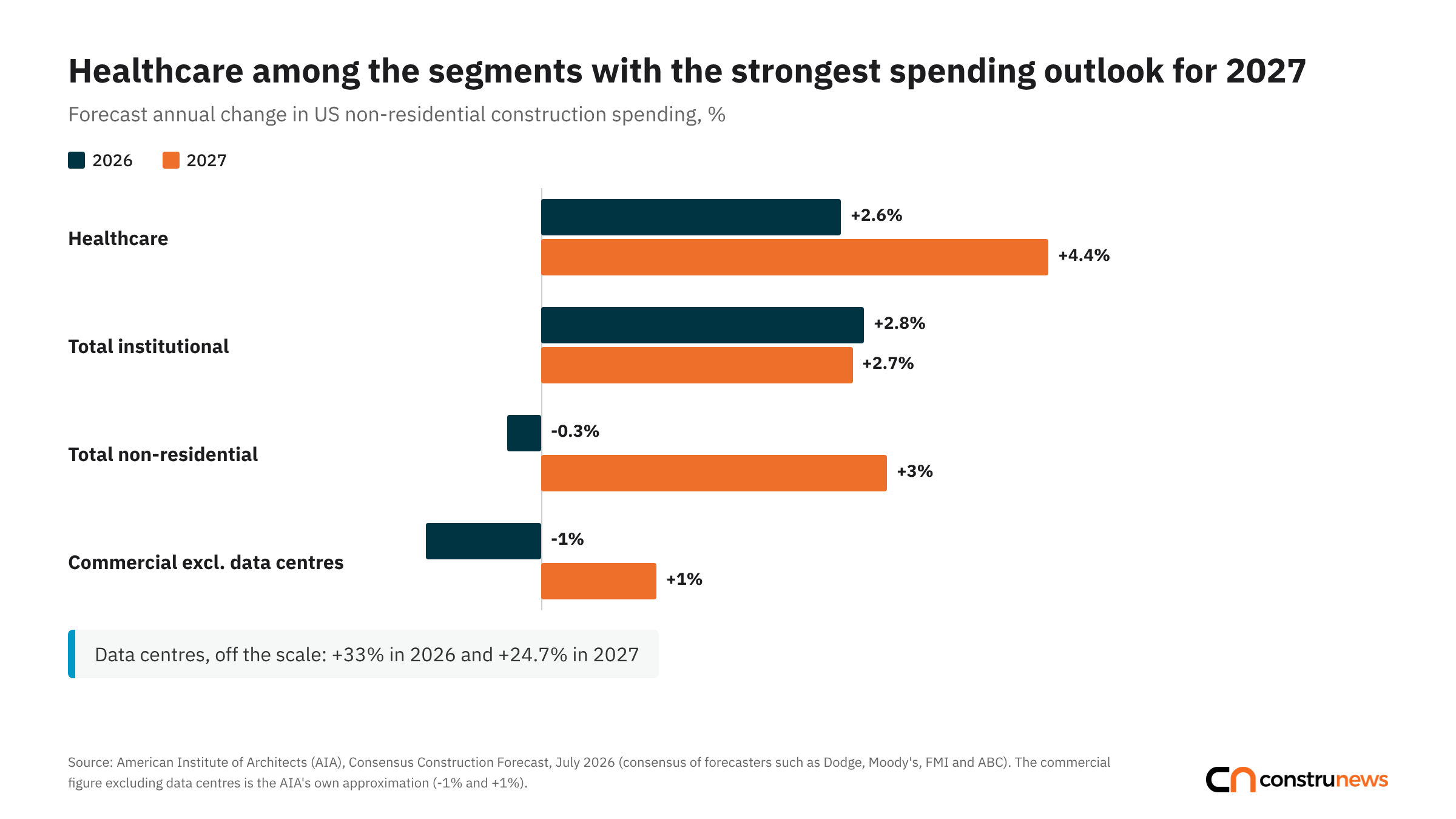
Healthcare has historically been an exception during slowdowns. The American Institute of Architects (AIA) Consensus Construction Forecast of July 2026 expects US healthcare construction spending to grow 2.6% in 2026 and accelerate to 4.4% in 2027, against a 0.3% fall in total non-residential spending this year and a 3% rise next year. Only data centres (+33% and +24.7%) show much stronger growth; without them, commercial building would fall by around 1% in 2026.
US healthcare construction will grow 4.4% in 2027, according to the AIA consensus, versus 3% for all non-residential
But demand does not guarantee funding. DPR’s Healthcare Market Trends Q4 2026 report, written by Espinosa and Sean Ashcroft and published on 3 November, notes that the year-to-date hospital operating margin index stood at 1.4% through July and that the Federal Reserve raised rates on 16 September for the first time in three years, to a 3.75%-4.00% range. According to Associated Builders and Contractors (ABC), construction input prices rose 1.2% in August and 8.9% year on year, with iron and steel, switchgear and copper wire and cable each up more than 10%.
Espinosa also points to competition for resources: “Data centers are a huge push, and that’s causing material and labor prices to increase.” Hospitals compete with them for the same mechanical and electrical trades. With “razor thin margins”, DPR expects many health systems to be unable to fund every project and recommends rephasing work, shifting scope towards renovation and ambulatory projects, securing cost certainty earlier in preconstruction and releasing long-lead equipment early. Two federal changes taking effect on 1 January 2027, to Medicaid and to the CMS outpatient payment system, reinforce, in the contractor’s view, the shift of activity from inpatient settings to ambulatory surgery centres, medical office buildings and freestanding imaging.
“I often say the only thing that has stayed the same about healthcare is how it’s spelled,” Espinosa quips.

